
How to Mix Your Dough (and Why it Matters)

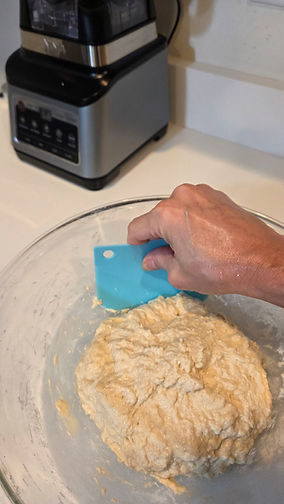
If you’ve ever baked a loaf that turned out dense, flat, or just… off, there’s a good chance the issue started at the very beginning, with how you mixed your dough.
Mixing isn’t just combining ingredients. It’s where structure begins, where gluten develops, and where your dough starts becoming bread.
And the better you understand this step, the easier everything else becomes.
This post may contain affiliate links. If you purchase through these links, I may earn a small commission at no extra cost to you.
Why Mixing Matters
When flour and water come together, gluten begins to form, creating the structure that traps gas and allows your dough to rise.
Good mixing gives you:
Stronger dough
Better fermentation
A lighter, more open crumb
Poor mixing can lead to:
Dense loaves
Sticky, hard-to-handle dough
Weak rise
👉 If you’re struggling with tight or heavy bread, I break that down more in “Why Is Your Sourdough Dense?”
Before You Mix: Understanding the Big Picture
Mixing doesn’t happen in isolation it’s part of a bigger process.
If you’re newer to sourdough, I’d highly recommend starting with:
Because how you mix your dough directly impacts how it ferments and vice versa.
The 4 Steps to Mixing Dough

1. Combine Flour + Water
Start by mixing your flour and most of your water until no dry bits remain.
You’re looking for:
A shaggy dough
No loose flour
💡 Pro tip: A dough whisk makes this step much easier
2. Let It Rest (Autolyse)
Let the dough rest for 20–60 minutes before adding anything else.
This allows:
Gluten to begin forming naturally
Dough to become more extensible
Less work during mixing
👉 I go deeper into this in “Autolyse vs Fermentolyse” if you want to understand when to use each.
3. Build Strength
Now it’s time to actually mix.
You can:
Stretch and fold
Mix in the bowl
Use a slap-and-fold method
You’ll notice the dough change from rough to smoother and more elastic.
👉 This step directly impacts fermentation strength, if that’s confusing, check out “Fermentation Made Simple”
4. Add Salt + Starter
Once your dough has some structure, add:
Starter (levain)
Salt
Mix until fully incorporated and cohesive.
How Mixing Affects Fermentation

This is where everything connects.
Well-mixed dough:
Ferments more evenly
Holds gas better
Is easier to shape
Under-mixed dough:
Spreads out
Feels slack
Struggles to rise
How Do You Know When You’re Done?

You don’t need a perfect windowpane—just look for:
Dough that holds together
A smoother surface
Slight resistance when stretched
Remember: you can continue building strength during bulk fermentation.
Common Mixing Mistakes
1. Not Mixing Enough
This is the most common issue I see.
👉 It’s also one of the biggest reasons behind dense loaves
2. Skipping the Rest
Autolyse makes everything easier. Skipping it means more work later.
3. Overcomplicating It
You don’t need fancy techniques just consistency and attention.
A Simple Mixing Routine (My Go-To)
If you want something straightforward:
Mix flour + water
Rest 30 minutes
Add starter + salt
Mix until cohesive
Move into bulk fermentation
Simple. Repeatable. Effective.
Recommended Tools
Dough whisk → for initial mixing
Bench scraper → for handling sticky dough
Large mixing bowl → gives you room to work
Kitchen scale → for accuracy (this is a BIG one for beginners)
💡 These are the tools I personally use in my microbakery and at home, nothing fancy, just reliable.
Final Thoughts
Mixing is one of the most underrated steps in bread baking—but it sets the tone for everything that follows.
If your dough feels better, everything gets easier:
Fermentation
Shaping
Scoring
Baking
And the best part? It’s a skill you build quickly with practice.
About the Baker

Hi, I'm Jenny, the baker behind Bread and More. I run a small microbakery where I bake sourdough breads, bagels, and baked goods for my community.
Here on the blog I share sourdough tips, baking lessons I've learned along the way, and simple guidance to help home bakers feel more confident baking sourdough.


Comments